Presentation of the Dossier: The Right to Science Under the Microscope
DOI:
https://doi.org/10.62169/rg.35.2971Keywords:
RIGHT TO SCIENCE, GENEALOGY, INTERNATIONAL LAW, PARTICIPATION, PROGRESSAbstract
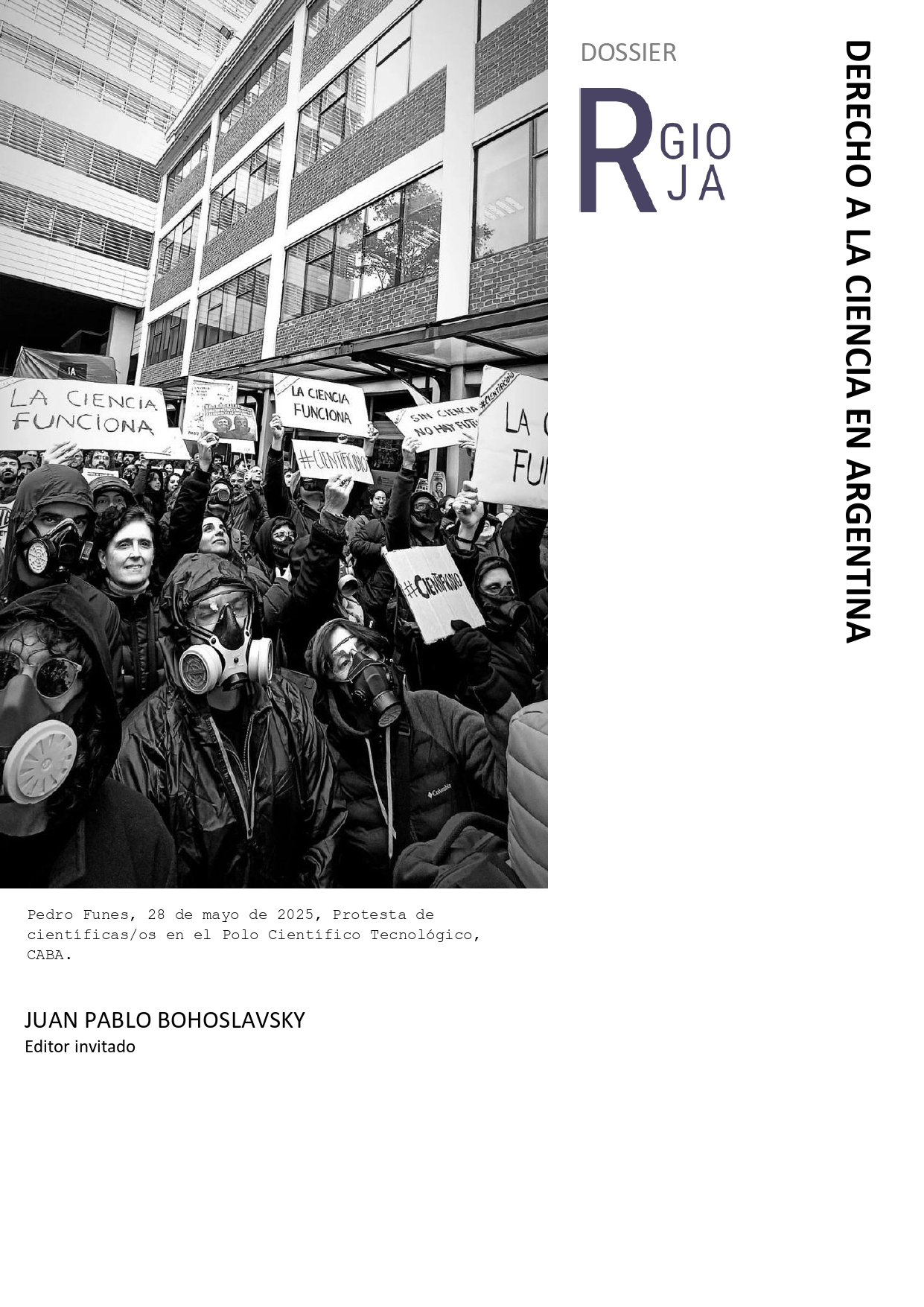
This article explains the reasons behind a dossier dedicated to the human right to science, a right that has gone unnoticed for decades, both in Argentina and the rest of the world. The article is contextualized in today's Argentina, marked by a government policy that threatens the right to science. It presents the genealogy of the right to science in its development in the field of international law and explains the substantive and procedural components that make up this right, in particular participation in the production of scientific knowledge, access to the benefits derived from science, and scientific freedom. It presents the articles that make up the dossier, which include the analysis of the right to science in relation to Artificial Intelligence, the governance of the scientific and technological system, scientific diplomacy, research in repressive contexts, scientific culture and social legitimacy from a historical perspective, and the public communication of science. Finally, it proposes a work agenda for strengthening the right to science.
Downloads
References
BAILEY OGILVIE, Marilyn (2010). Marie Curie: A Biography, Prometheus Books.
BESSON, Samantha (2023). The ‘Human Right to Science’ qua right to participate in science. The participatory good of science and its human rights dimensions. International Journal of Human Rights, 28(3), pp. 497-528.
BOHOSLAVSKY, Juan Pablo; CARDINAUX, Nancy y SCIOSCIOLI, Sebastián (2025). Ciencia y educación universitaria bajo ataque (pp. 261-280) En BOHOSLAVSKY, Juan Pablo (ed.), Lo mío es mío y lo tuyo es mío – Neoliberalismo y derechos humanos en Argentina, Edulp.
BOHOSLAVSKY, Juan Pablo (2022). Pluralidad epistémica y derechos humanos e pandemia (pp. 25-50). En Bohoslavsky, Juan Pablo (ed.), Ciencias y pandemia. Una epistemología para los derechos humanos, EDULP.
CLÉRICO, Laura, ALDAO, Martín, & SCARAMUTTI, Mayra. (2025). Las medidas económicas regresivas bajo la lupa contextual: Claves constitucional e interamericana para la movilización y el litigio. En BOHOSLAVSKY, Juan Pablo (Ed.), Lo mío es mío y lo tuyo es mío – Neoliberalismo y derechos humanos en Argentina. Edulp.
CORMICK, Claudio, y EDELSZTEIN, Valeria. (2025). El discurso de Milei detrás del cientificidio argentino. Ciencia, Tecnología y Política, 8(14).
DONDERS, Yvonne. (2024). The right to science: Another tool to repair gender inequalities in sciences and research. En Andrea BRODERICK & Jennifer SELLIN (Eds.), Socio-economic rights, inequalities and vulnerability in times of crises: Building back better. Edward Elgar Publishing.
DONDERS, Yvonne, y PLOZZA, Monika (2023). Look before you leap: States’ prevention and anticipation duties under the right to science. International Journal of Human Rights, 28(3), 354–379.
ESPINOZA HERNÁNDEZ, Raymundo, y GÓMEZ RUÍZ, Keila (2022). El derecho humano a la ciencia: Contenido, principios y garantías. Revista del Posgrado en Derecho de la UNAM, 10(17), 17–23.
ESTEBAN, Pablo (2025). Inocentes. La ciencia forense en el laberinto judicial. El Gato y la Caja.
FEYERABEND, Paul (1975). How to defend society against science. Radical Philosophy, (11), 3–8.
FLETCHER, Laurel, ROZO ANGEL, Valentina, y SIM, Ariel (2025, 6 de agosto). Why data science belongs at the heart of international human rights advocacy. Open Global Rights.
HAUGEN, Hans (2024). A human right to science: Inadequate without participation in science? Human rights as a governance tool in scientific fields. Nordic Journal of Human Rights, 43(1), 1–18.
HURET, Romain (2025). ¿El fin de las ciencias sociales? Tradición y modernidad del antiintelectualismo en Estados Unidos. Nueva Sociedad, (316).
MANCISIDOR, Mikel (2022). La ciencia como derecho humano. En BOHOSLAVSKY, Juan Pablo (Ed.), Ciencias y pandemia: Una epistemología para los derechos humanos. Edulp.
MAZIBRADA, Andrew, PLOZZA, Monika, y PORSDAM MANN, Sebastian (2023). Innovating in uncharted terrain: On interpretation and normative legitimacy in the CESCR’s General Comment No. 25 on the right to science. International Journal of Human Rights, 28(3), 148–176.
NATAPOF, Daniel (2025). Posverdad y crisis de confianza en la ciencia: El comienzo [Manuscrito no publicado]. Seminario “Filosofía, ciencia y sociedad”, Maestría en Ciencia, Tecnología e Innovación, UNRN.
PÁEZ, Andrés, GUTIÉRREZ, Juan D., y ACOSTA-NAVAS, Diana (2025). Hacia una inteligencia artificial centrada en los seres humanos: Contribuciones de las ciencias sociales. Revista de Estudios Sociales, 93, 3–18.
PINKER, Steven (2018). En defensa de la Ilustración: Por la razón, la ciencia, el humanismo y el progreso. Paidós.
PIOVESAN, Flavia, y TUELLER, Jessica (2022). Políticas públicas y estándares interamericanos: El derecho al goce de los beneficios del progreso científico. En BOHOSLAVSKY, Juan Pablo (Ed.), Ciencias y pandemia: Una epistemología para los derechos humanos. Edulp.
PORSDAM, Helle, y PORSDAM MANN, Sebastian (Eds.) (2021). The right to science: Then and now. Cambridge University Press.
ROMANO, Cesare, y BOGGIO, Andrea (2024). The human right to science: History, development, and normative content. Oxford University Press.
SABA, Roberto (2021). Derecho a la ciencia: Una mirada desde los derechos humanos. Policy Briefs UNESCO. https://unesdoc.unesco.org/ark:/48223/pf0000374224
SCHABAS, William (2007). Study of the right to enjoy the benefits of the scientific and technological progress and its applications. En Y. DONDERS & V. VOLODIN (Eds.), Human rights in education, science and culture. UNESCO/Ashgate.
SCHABAS, William (2023). Codifying the human right to science. International Journal of Human Rights, 28(3), 313–334.
TÜRK, Volker (2023, 3 de noviembre). Protect the ‘right to science’ for people and the planet. Nature. https://www.nature.com/articles/d41586-023-03332-8#author-0
ZIMAN, John. (2023). Ciencia y sociedad civil. Isegoría, 28, 5–17.
Documentos:
Comisión de Derecho Internacional (2016). Fragmentación del derecho internacional: Dificultades derivadas de la diversificación y expansión del derecho internacional (Informe del Grupo de Estudio; A/CN.4/L.682, 13 de abril de 2006). Naciones Unidas.
Comisión Interamericana de Derechos Humanos (CIDH) (2018). Políticas públicas con enfoque de derechos humanos (OEA/Ser.L/V/II. Doc. 191). http://www.oas.org/es/cidh/informes/pdfs/PoliticasPublicasDDHH.pdf
Comisión Interamericana de Derechos Humanos (CIDH) (2019). Empresas y derechos humanos: estándares interamericanos (OEA/Ser.L/V/II; CIDH/REDESCA/INF.1/19). http://www.oas.org/es/cidh/informes/pdfs/EmpresasDDHH.pdf
Comisión Interamericana de Derechos Humanos (CIDH) (2021). La CIDH y su REDESCA llaman a los Estados Americanos a poner la salud pública y los derechos humanos en el centro de sus decisiones y políticas sobre vacunas contra el COVID-19 [Comunicado de prensa No. 027/21]. https://www.oas.org/es/CIDH/jsForm/?File=/es/cidh/prensa/comunicados/2021/027.asp
Comité de Derechos Económicos, Sociales y Culturales (CDESC). (2020). Observación general núm. 25 relativa a la ciencia y los derechos económicos, sociales y culturales (artículo 15, párrs. 1 b), 2, 3 y 4, del PIDESC) (UN Doc. E/C.12/GC/25).
elDiarioAR (2024, 6 de marzo). Dura carta de 68 Premios Nobel a Milei preocupados por el sistema científico argentino. https://www.eldiarioar.com/politica/dura-carta-68-premios-nobel-milei-preocupados-sistema-cientifico-argentino_1_10986976.html
Grupo de Trabajo del Protocolo de San Salvador (2015). Indicadores de progreso para la medición de derechos contemplados en el Protocolo de San Salvador (OEA/Ser.D/XXVI.11). https://www.oas.org/en/sedi/pub/indicadores_progreso.pdf
Relatora Especial sobre los derechos culturales (2012). Derecho a gozar de los beneficios del progreso científico y sus aplicaciones (UN Doc. A/HRC/20/26).
Relatora Especial sobre los derechos culturales (2021). La COVID-19, la cultura y los derechos culturales (UN Doc. A/HRC/46/34).
Relatora Especial sobre los derechos culturales (2024). Derecho a participar en la ciencia (UN Doc. A/HRC/55/44).
UNESCO (2021). Recomendación sobre ciencia abierta. https://unesdoc.unesco.org/ark:/48223/pf0000378841
Downloads
Published
Issue
Section
License
Copyright (c) 2025 Leticia Vita

This work is licensed under a Creative Commons Attribution-NonCommercial 4.0 International License.
Los/as autores/as que publican en esta revista están de acuerdo con los siguientes términos:
1. Los/as autores/as conservan los derechos de autor y garantizan a la revista el derecho de ser la primera publicación del trabajo al igual que licenciado bajo una Creative Commons Attribution-NonCommercial 4.0 International License que permite a otros compartir el trabajo con un reconocimiento de la autoría del trabajo y la publicación inicial en esta revista.
2. Los/as autores/as pueden establecer por separado acuerdos adicionales para la distribución no exclusiva de la versión de la obra publicada en la revista (por ejemplo, situarlo en un repositorio institucional o publicarlo en un libro), con un reconocimiento de su publicación inicial en esta revista.
3. Se permite y se anima a los/as autores/as a difundir sus trabajos electrónicamente (por ejemplo, en repositorios institucionales o en su propio sitio web) antes y durante el proceso de envío, ya que puede dar lugar a intercambios productivos, así como a una citación más temprana y mayor de los trabajos publicados (Véase The Effect of Open Access) (en inglés).